
The Complete Guide to NY Labor Law Section 224-g Compliance and Reporting Pay Mandates

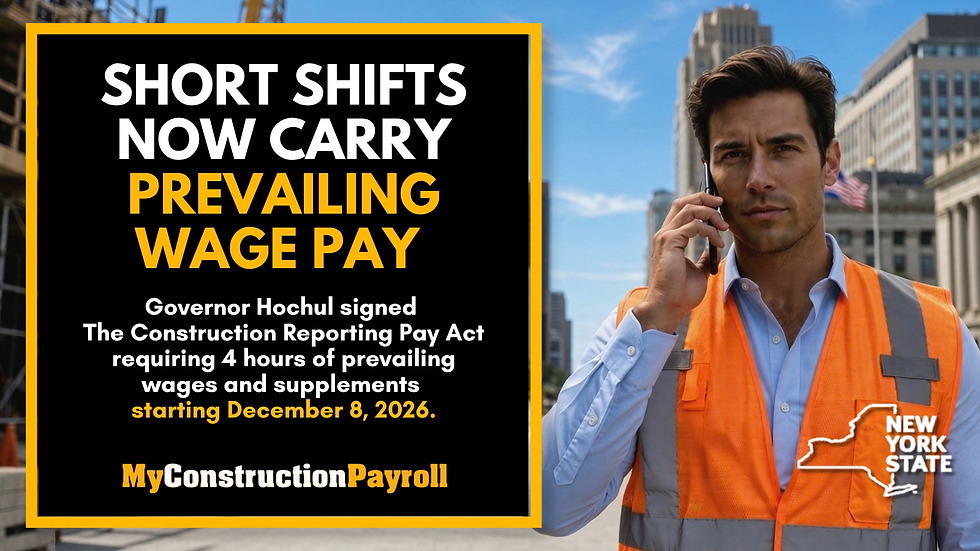
Executing public construction projects across New York, New Jersey, and Pennsylvania requires absolute adherence to official state statutes. A primary regulatory obligation for public works contractors operating in New York centers on NY Labor Law Section 224-g compliance, following the statutory enactment of the Construction Reporting Pay Act taking effect December 8, 2026.
Contractors and back-office compliance officers can review the official enacted bill directly via the New York State Senate Legislative Database (Bill A06950), or reference the permanent code in the New York Consolidated Laws Database (Labor Law § 224-g).
This state statute establishes strict reporting pay minimums for all laborers, workers, and mechanics employed on public works construction contracts subject to Article 8 of the NY Labor Law.
Under NY Labor Law § 224-g, whenever a covered employee reports for work on any day by request or permission of the employer, they must be paid no less than four hours at the prevailing rate of wages and supplements for their designated trade classification. Even if rain, material delays, or site cancellations send workers home after one hour, the statute mandates full four-hour prevailing pay plus mandatory fringe supplements.
Furthermore, if a scheduled shift is canceled with less than 12 hours' notice, the law obligates contractors to pay two hours of prevailing wages and supplements.
Generic payroll software applications simply process raw field hours entered by back-office clerks. They do not calculate statutory 4-hour minimums or validate whether partial-day timecards comply with state public works laws before certified payroll records are generated.
Understanding the Financial Risk of Non-Compliance Under NY Labor Law § 224-g Com
State enforcement agencies have integrated statutory cross-checks directly into electronic submission portals like NYSDOL MPWR. Under Section 224-g(1) of the New York Consolidated Laws, reporting pay amounts are legally classified as prevailing wages and supplements.
When certified payroll transcripts reflect short-shift hours without adjusting for statutory 4-hour prevailing minimums, state auditing systems automatically flag the filing. Similar strict statutory enforcement exists in surrounding states, such as New Jersey's custom fabrication mandate under N.J.S.A. 34:11-56.26 and federal site-of-work standards under 29 CFR § 5.2.
Relying on standard payroll software creates severe operational and financial risk:
Automatic Wage Reclassifications: State labor auditors recalculate partial shifts to full 4-hour prevailing wage minimums, assessing retroactive back-wages and unpaid fringe supplements.
Frozen Progress Draws: Contracting agencies and general contractors routinely withhold progress payments from subcontractors the moment a state prevailing wage compliance flag appears.
Compounding Civil Penalties: The NYSDOL assesses statutory interest and civil penalties for every unadjusted timecard line item across every weekly filing period.
Public Works Debarment: Willful or repeated failure to pay full prevailing wages and supplements risks debarment from bidding on public contracts for up to three years.
Once a state auditor flags a reporting pay discrepancy on one job site, the investigation routinely expands to cover every active public contract in your firm's portfolio.
Building an Audit-Proof Framework for Reporting Pay and Certified Filings
Eliminating compliance friction requires replacing generic software subscriptions with an operational framework engineered specifically for construction trades.
Generic Payroll Software vs. Managed Construction Framework
Statutory Reporting Pay Validation
Generic Software: Relies on manual staff entry with zero checks for state 4-hour reporting pay rules.
Managed Framework: Cross-checks field timecards against state laws (including NY Labor Law § 224-g) before payroll runs.
Fringe Supplement Allocation
Generic Software: Calculates basic cash deductions, leaving tax-exempt fringe supplement rules on reporting pay to internal staff.
Managed Framework: Automatically calculates tax-exempt bona fide fringe credits on all reporting pay hours to optimize tax savings.
Certified Portal Submissions
Generic Software: Generates raw data exports requiring manual staff formatting and portal uploads.
Managed Framework: Validates and submits audit-ready certified reports directly to state regulatory portals on time.
Audit Representation
Generic Software: Hands-off approach that leaves your internal team to deal with state labor investigators alone.
Managed Framework: Hosts and manages Workers' Comp, General Liability, and Union audits directly inside our office.
Proactive Protection for Reporting Pay Before the Audit Hits
Partnering with specialized trade payroll experts transforms how your back office handles public works compliance across NY, NJ, and PA:
Pre-Filing Wage Verification: Every worker classification, hourly rate, shift length, and daily timecard is verified against official county wage schedules before payroll is finalized.
Automated Union & Benefit Reconciliation: Local union dues, trust fund contributions, and prevailing fringe supplements are tracked automatically to preserve tax credits.
In-Office Audit Shield: If a state labor department, union trust, or insurance carrier requests an audit, My Construction Payroll hosts the auditors at our location. We pull the files, present verified records, and defend your submissions while your crew stays focused on executing job site contracts.
Eliminate back-office guesswork and protect your project retainage. Transitioning your firm to specialized NY Labor Law Section 224-g compliance infrastructure guarantees complete regulatory alignment across every project phase. Get Ahead of December 8th, 2026.
__________________________________________________________________________________
FREQUENTLY ASKED QUESTIONS (FAQS)
Q1: When does NY Labor Law § 224-g take effect for public works construction projects?
A1: NY Labor Law § 224-g officially takes effect on December 8, 2026. Starting on this date, covered workers on Article 8 projects who report for duty must receive at least 4 hours of pay at their required prevailing wage rate and fringe benefit supplements. Official statutory text is available on the NY Senate Consolidated Law Database and legislative history via NY Senate Bill A06950.
Q2: Are reporting pay hours considered prevailing wages under New York law?
A2: Yes. Under NY Labor Law § 224-g(1), statutory reporting pay is legally classified as prevailing wages and supplements. Failure to properly report and pay these 4-hour minimums on certified filings is enforced as a wage underpayment.
Q3: How does an in-office audit shield protect our internal staff during a DOL review?
A3: When a state labor department, union trust, or insurance auditor requests a project audit, My Construction Payroll hosts the audit directly inside our office. We manage all auditor requests, supply verified timecard histories, and defend your compliance files so your staff isn't pulled away from job site operations.
Comments